


Taking the Waters


I would imagine that the early American settlers who established their living on the farm we now call Sunshine Springs did so precisely because of the latter part of our namesake: the springs. Pre-indoor plumbing, a nearby freshwater source was crucial. Whereas those in an urban setting relied on cider, beer, and whisky, denizens of the countryside could count on their freshwater as safe sources of refreshment.
The numerous springs in western Virginia drew many—including such well-knowns as George Washington and Thomas Jefferson—to this region in the 18th and 19th centuries. “Taking the waters” at the area's mineral springs was pursued for both restoration of health and as a means of entertainment or socializing. Warmed by the natural temperature gradient of Earth’s crust caused by the decay of radioactive materials, the groundwater at these thermal springs makes a quick return to the surface and produces springs that range in temperature from the low 60s to 106 degrees Fahrenheit. At these sites, water percolating through the 400-million-year-old sandstone and limestone of the Valley and Ridge region encounters an impermeable rock layer and is essentially bounced back to the surface so fast that it doesn’t have time to lose its accumulated heat. Evidence suggests that residents of this land have been “taking” these super-heated waters for at least the last 9,000 years.
Whereas reports conflict as to the health benefits of thermal and mineral springs, the health benefits of cool springs prior to the advent of electricity-generated refrigeration are clear. Springs like ours, where the groundwater table breaches the soil’s surface, tend to maintain a temperature of around 56 degrees Fahrenheit all year round. As a result, early American settlers built spring houses with pools in which milk, butter, and cheese could be kept cool. In the mid-1900s, when the property’s farmers raised dairy cattle, refrigeration provided by the spring-cool waters kept the milk from spoiling.

If you had asked Dad, he would have said that the best part of having a spring on the property is the taste of the water. That slow seepage through porous rock layers allows for any suspended sediments and particles in the water to settle out, running clear as it trickles out of the ground. Regardless of the fact that clarity and taste are poor indicators of most water contaminants, Dad would probably agree with a survey respondent who reported, “I love good old mountain spring water and truly believe it’s better than any nasty, chlorine tasting city water.” According to researchers at Virginia Tech, collecting water from roadside or “spout” springs is a regular source of household water for some communities in Appalachia. For many respondents to the researchers’ survey, a preference for the taste of spring water led them to collect from spout springs despite having in-home water sources. Even though ours is not a publicly accessible spring, our neighbor had a gentlemen’s agreement with Dad and regularly frequented a pump on our property as his source of drinking water.
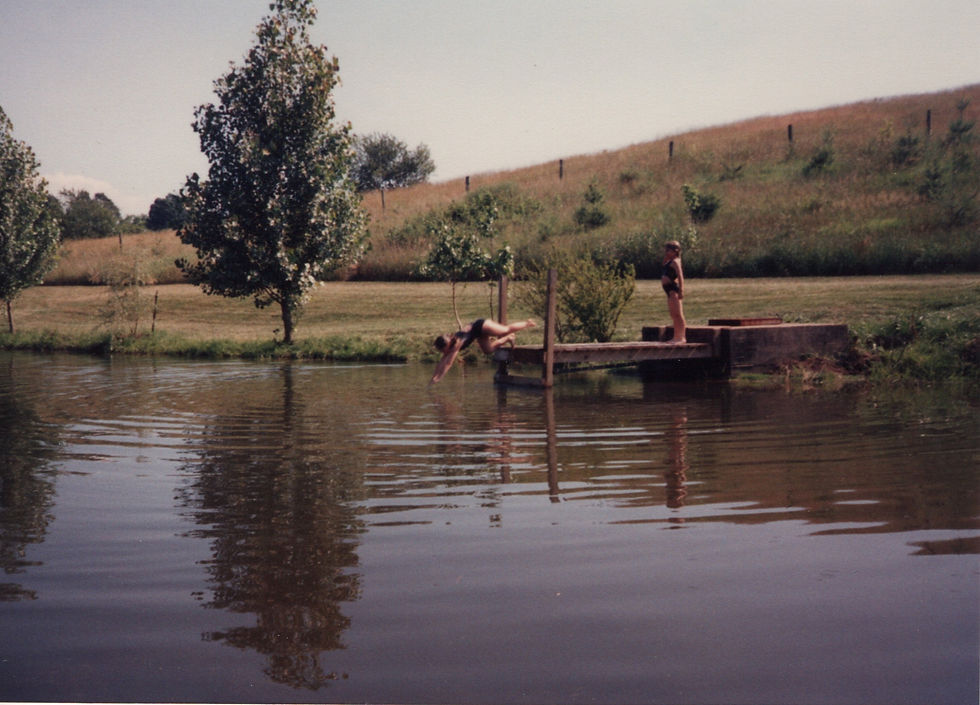
Water is vital on the farm. But now that we’ve had the hubris to attempt to control it, it reminds us that it’s in charge, not us. The pond that Dad carved out of a swampy wetland is filling in due to an accumulation of eroded dirt and detritus and the natural state of squishy soil is slowly returning. On higher ground, we find ourselves with no running water at the farmhouse, as the century-old pump that reliably brought water to the house for most of my lifetime has again failed—this time without Dad to MacGyver a fix. Yet, while waiting to meet a well-pump fellow who might be able to offer a solution, we discovered that water was indeed getting into the house—through the walls of the basement. Torrential downpours on misaligned gutters had infiltrated the foundation. It is water’s natural tendency to be taken in.
Armed with woefully inadequate weapons of old towels and contractor bags, Caroline and I attempted to relocate the water. We sopped up the sludge of muddy water and moldy cardboard, wedged the gutter a little higher with a length of bamboo, and crossed our fingers against the next rainstorm. As long as we are the caretakers of this land, we will continue to take the waters—in all the ways that it seeks to be taken. We know who’s in charge here.
Further reading:
What was in colonial cups besides tea? by Melissa Swindell
The Mineral Springs of Western Virginia by William Burke
Thermal Springs in Virginia and Springs in Virginia by Charlie Grymes
Water Scavenging from Roadside Springs in Appalachia by researchers at Virginia Tech


Comments